Clayford T. Grimm, P.E. Student Scholarship
Deadline
July 31
Established in 2007 to honor the memory of Clayford T. Grimm, this Scholarship is awarded every year to a Master’s level graduate student who is conducting research in masonry. The investigation can be in masonry materials, structures, construction, or architecture and must be performed under the direction of a member of The Masonry Society.
Award Value: $1,000 (USD)
About Clayford T. Grimm

Clayford T. Grimm, or Tom, as his many friends knew him, was a licensed structural engineer and noted author and friend. Prior to his untimely death in 2003, he had authored more engineering literature on masonry than any other living American. His published works include more than 170 papers in virtually all of the national architectural and engineering journals.
Mr. Grimm served as an adjunct member of the architectural engineering faculty at The University of Texas at Austin for 22 years where he taught undergraduate and graduate courses in masonry engineering and in construction specifications and contracts.
As a member of TMS, Tom served in nearly every role. Besides being a founding member, he served on most TMS committees including the Board of Directors and the Technical Activities Committee. He was the first chair of the Task Group that developed TMS’s website and he greatly assisted TMS in establishing relationships with various international groups. For his contributions, he was presented the President’s Award in 1995 and was made an Honorary Member of TMS in 1997. To honor his memory, The Masonry Society created the Clayford T. Grimm, P.E. Student Scholarship in 2007.
A recognized masonry expert and world traveler Mr. Grimm was internationally known throughout the masonry arena. He received the rare and treasured award of Honorary Member in the British Masonry Society of which he was a founding member. He was arguably the best known American in masonry. His longtime and dear British Colleague H.W.H. West described Tom Grimm as an international colossus, known and respected in ASTM, ASCE, ACI, TMS, Rilem, CIB, ISO, and BMS.Professor Paul Haller was a dynamic engineer who helped revolutionize the design of structural masonry. Haller was born on March 7, 1902 in Zurich, Switzerland. He was formally educated at the Federal Technical University in Zurich, graduating in 1924.
Master’s level graduate student conducting research in masonry
Faculty advisor must be a current TMS member
Academic Background
Applicants must hold a bachelor’s degree from a regionally or nationally accredited institution before the scholarship period begins (a degree is not required at the time of application).
Program Enrollment
By the time of scholarship acceptance, applicants must be admitted to a graduate program in engineering, construction, architecture, or materials science — with a focus on masonry design, materials, or construction.
Recipients must remain enrolled as full-time graduate students for the entire scholarship period.
English Proficiency
Applicants must be proficient in English. Those whose native language is not English must submit a TOEFL or GRE score.
Faculty Advisor
The applicant’s graduate faculty advisor must:
Award recipients will be notified promptly after selection, which will be finalized by August 15th of the award year.
Official recognition will take place at The Masonry Society’s Annual Meeting.
TMS will notify the recipient’s university of the award details, including the recipient’s name, award amount, and payment conditions.
Funds will be deposited directly into the recipient’s account through the university’s business office and disbursed in equal installments over one academic year — two installments for semester-based schools, three for quarter-based schools.
The first installment is released upon proof of graduate enrollment. Each subsequent installment requires receipt and approval of a progress report from the faculty advisor.
The faculty advisor must submit a progress report to the TMS Scholarship Committee before each subsequent installment is released.
Recipients are also expected to:
Latest Scholarships
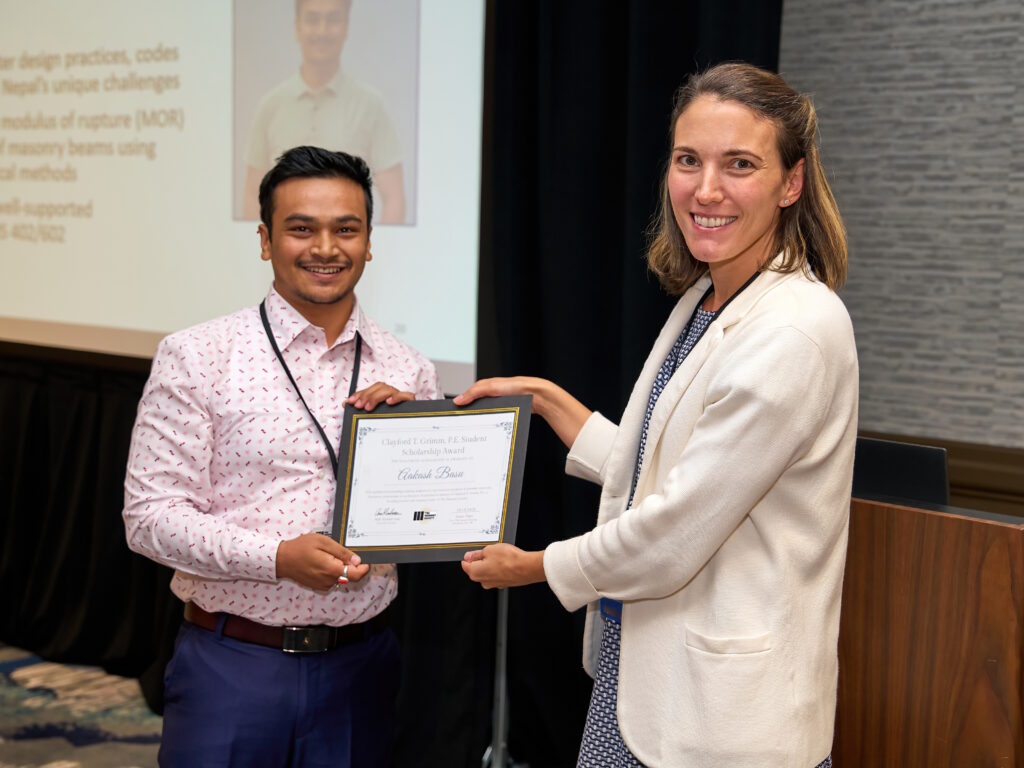
2025 Clayford T. Grimm Student Scholarship Awarded to Aakash Basu
Aakash Basu, Clemson University, was awarded with the Grimm Student Scholarship during The Masonry Society’s Annual Meeting on October 16, 2025 in Oklahoma City, Oklahoma. Aakash’s research focuses on evaluating…