TMS eStore

Showing 161–166 of 166 results

  • Comparison of Reinforced Masonry Design: Project Overview and Design Examples

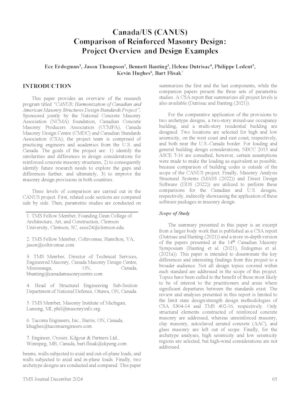
    Comparison of Reinforced Masonry Design: Project Overview and Design Examples

    $25.00

    Authors: Ece Erdogmus, Jason Thompson, Bennett Banting, Helene Dutrisac, Philippe Ledent, Kevin Hughes, Bart Flisak

    TMS Journal Volume 42, December 31, 2024

    Abstract

    This work is the first one of the four companion papers associated with the Canada/US (CANUS) collaborative project: Harmonization of Canadian and American Masonry Structures Design Standards. This paper provides an overview of the key differences in reinforced concrete masonry design provisions between the two countries. The first part of the paper summarizes these differences in a discussion format, while the second part provides two design examples: a two-story mixed-use occupancy building and a multi-story residential building. Two locations are selected for high and low seismicity. While the critique of the building codes is out of the scope of this study, when appropriate, differences regarding the loading considerations from NBCC 2015 and ASCE 7-16 are highlighted. In some cases, the corresponding design checks align closely between the two countries’ design standards, while in other cases there are minor to significant differences. There are also instances where one of the standards is silent on a topic while the other addresses it comprehensively. In general, it is observed that TMS 402-16 allows a larger applicability of masonry design compared to CSA S304-14 due to the compounding effect of lower trust in masonry’s material strength and stricter considerations in design equations.

    Keywords: Reinforced masonry design, masonry codes, compressive strength of masonry, TMS 402-16, CSA S304-14
  • Comparison of Masonry Beam Design and Detailing Provisions

    Comparison of Masonry Beam Design and Detailing Provisions

    $25.00 (PDF)

    Authors: Ece Erdogmus, Richard Bennett, Jason Thompson, Bennett Banting

    TMS Journal Volume 42, December 31, 2024

    Abstract

    This work is one of the four companion papers associated with the Canada/US (CANUS) collaborative project: Harmonization of Canadian and American Masonry Structures Design Standards. This particular paper specifically delves into a comparison of the design and detailing provisions for masonry beams in the U.S. and Canada. The scope of the investigation covers the similarities and divergences between the two design standards (CSA S304-14 and TMS 402-16), through first a comparative discussion of the provisions followed by parametric studies that illustrate the differences quantitatively.

    Several areas of further investigation are identified as a result of this work, which if addressed, may improve and harmonize the two standards and practices. For instance, the χ factor utilized in CSA S304-14 amplifies the divergence such that most masonry beam designs that have been safely constructed in the U.S. are not possible in Canada. In contrast, TMS 402-16 does not have clear guidance on deflection limits or intermediate reinforcement for regular beams; and a reconsideration for modulus of rupture values may be warranted, as the code- provided values are based on historic wallette tests instead of beams.

    Keywords: Masonry beams, flexure, modulus of rupture, strength design, TMS 402, CSA S304


  • Comparison of Out-of-Plane Reinforced Masonry Wall Design Provisions

    Comparison of Out-of-Plane Reinforced Masonry Wall Design Provisions

    $25.00 (PDF)

    Heather Sustersic, David Stubbs, Russ Peterson, Richard M. Bennett, Clayton Pettit, Bart Flisak, Ece Erdogmus, Jason Thompson, Semsi Coskun, Bennett Banting, Carlos Cruz-Noguez

    TMS Journal Volume 42, December 31, 2024

    Abstract

    As part of a larger project jointly sponsored by the National Concrete Masonry Association (NCMA) Foundation, Canadian Concrete Masonry Producers Association (CCMPA), Canada Masonry Design Centre (CMDC) and Canadian Standards Association (CSA), a team of engineers and researchers from U.S. and Canada worked together to examine the key differences and similarities between the design provisions for reinforced masonry walls subject to out-of-plane (OOP) and axial loads. The scope was limited to the strength design provisions of TMS 402-16 and the limit state design provisions of CSA S304-14 masonry design standards. Several parametric studies were conducted to quantify the comparisons, as well as to identify possible limitations within each code. These studies explored factors that directly impact the calculation of combined flexural and axial capacity, wall stiffness, second-order moments, and shear capacity of the masonry walls subjected to OOP loading. Parameters considered include the compressive strength of the masonry assembly, wall geometry, as well as the size, strength and spacing of the steel reinforcement. In general, it was found that the Canadian provisions are more conservative than those in the U.S. The paper also provides a list of areas of further research or code revisions that should be considered in the future. It is the team’s goal to propose improvements to both codes as a result of this work.

    Keywords: Flexure, Axial Capacity, Out-of-Plane Resistance of Walls, Reinforced Masonry Walls, Strength Design, TMS 402, CSA S304


  • Comparison of Reinforced Masonry Shear Wall and Seismic Design Provisions

    Comparison of Reinforced Masonry Shear Wall and Seismic Design Provisions

    $25.00 (PDF)

    Authors: Ece Erdogmus, Carlos Cruz-Noguez, Phillipe Ledent, Lane Jobe, Kevin Hughes, Bennett Banting, Jason Thompson

    TMS Journal Volume 42, December 31, 2024

    Abstract

    As part of a larger project titled, CANUS: Harmonization of Canadian and American Masonry Structures Design Standards Project, in this paper, the design provisions in TMS 402-16 and CSA S304-14 are compared for reinforced concrete masonry shear walls subject to in-plane forces. The scope of the work covers in-plane bending and axial force interactions, shear capacity calculations, and seismic provisions for fully grouted reinforced concrete masonry shear walls. Seven parametric studies and two case studies are utilized to quantify the impact of some of the differences. The parametric studies include exploration of the effects of the wall aspect ratio, compressive strength of masonry, maximum reinforcement limitations and ductility requirements, material or capacity reduction factors, maximum compressive strain, and the artificial moment arm reduction considerations, as well as seismic wall categories and prescriptive seismic detailing requirements. The authors find that in most cases, the Canadian approach is more conservative than the U.S. The main contributor to this discrepancy is a large difference in the typical masonry compressive strength (f’m) values used in Canada and the U.S. By contrast, the maximum reinforcement ratio combined with a lower maximum strain in U.S. design can limit the height of reinforced masonry walls, especially in high seismic areas. The main product of this project is a list of potential future research studies for the resolution of some of the issues highlighted in this paper that can help improve and harmonize both countries’ masonry design provisions.

    Keywords: Reinforced masonry shear walls, TMS 402, CSA S304, In-plane behavior of masonry shear walls, Seismic design of shear walls


  • TMS Responds, Vol. 22, No. 1

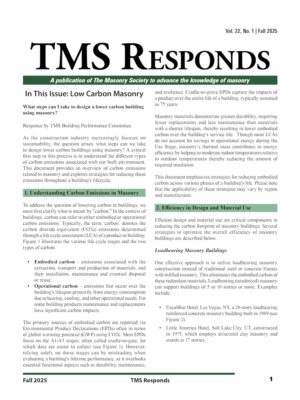
    TMS Responds, Vol. 22, No. 1

    $10.00 (PDF)

    Embodied Carbon and Whole Life Carbon in Masonry Design

    Discover practical strategies for reducing the carbon footprint of masonry buildings in this volume of TMS Responds. Prepared by The Masonry Society’s Building Performance Committee, this technical Q&A explains embodied vs. operational carbon, highlights efficient design methods, and explores innovative materials and manufacturing practices that support sustainable construction.

  • Performance of stone and timber-laced unreinforced masonry buildings during the 2023 KahramanmaraÅŸ Earthquakes in Türkiye

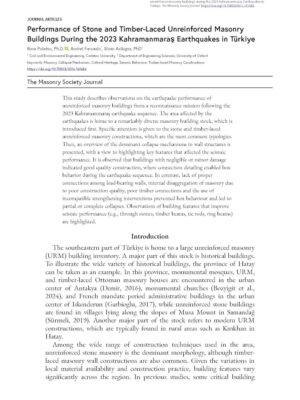
    Performance of stone and timber-laced unreinforced masonry buildings during the 2023 Kahramanmaraş Earthquakes in Türkiye

    $25.00 (PDF)

    Short Description (Visual/HTML tab) Appears: Between price and Add to Cart button ===================================================== -->

    TMS members receive this paper at no additional cost. Log in or join TMS to apply the member discount.

    This study examines the impact of the 2023 KahramanmaraÅŸ earthquake on unreinforced masonry buildings, highlighting the importance of quality construction and proper connections for seismic performance.
    Read more.

    Authors: Bora Pulatsu, Andrei Farcasiu, Sinan Acikgoz

    Published Ahead of Issue — May 22, 2026

    ↓ PDF download provided after purchase