-
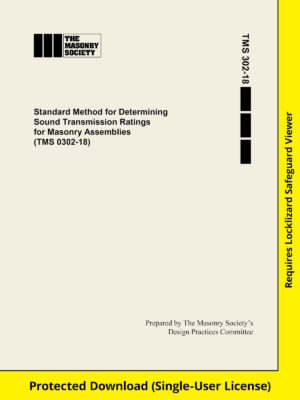
$40.00
The TMS 302 Sound Standard provides minimum requirements for rating masonry walls for sound transmission class (STC) and outdoor-indoor transmission class (OITC) based on testing calibrated calculation procedures.
Topics covered include reference standards, definitions and notations, materials, construction, and methods to STC and OITC rating for concrete masonry and clay masonry assemblies.
TMS 302-18 is adopted by reference in the 2021 International Building Code.
Other Formats
-
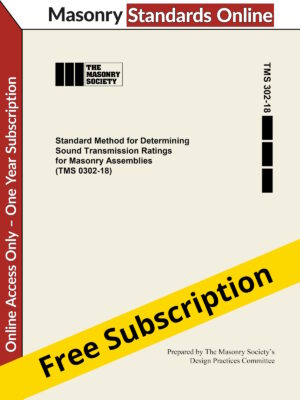
$0.00 for 1 year
The TMS 302 Sound Standard provides minimum requirements for rating masonry walls for sound transmission class (STC) and outdoor-indoor transmission class (OITC) based on testing calibrated calculation procedures.
Topics covered include reference standards, definitions and notations, materials, construction, and methods to STC and OITC rating for concrete masonry and clay masonry assemblies.
TMS 302-18 is adopted by reference in the 2021 International Building Code.
Available through Masonry Standards Online thanks to the support of
Select the number of users/seats:
-
$99.00
This Code prescribes minimum design and construction requirements for energy efficiency of building envelopes of new buildings and additions to buildings. It applies to buildings having concrete walls, roofs, or floors; masonry walls; and masonry veneer, including veneer attached to frame walls as part of the building envelope. It also provides minimum thermal properties for these assemblies for code compliance.
This Code is applicable to commercial and mid- to high-rise residential buildings that use either electricity from any generation source or fossil fuel. It can be used with applicable energy codes and standards such as ASHRAE 90.1 and the International Energy Conservation Code (IECC).
This protected download cannot be printed.
-
$99.00
This Code prescribes minimum design and construction requirements for energy efficiency of building envelopes of new buildings and additions to buildings. It applies to buildings having concrete walls, roofs, or floors; masonry walls; and masonry veneer, including veneer attached to frame walls as part of the building envelope. It also provides minimum thermal properties for these assemblies for code compliance. This Code is applicable to low-rise residential buildings that use either electricity from any generation source or fossil fuel. It can be used with applicable energy codes and standards such as the International Energy Conservation Code (IECC).
This protected download cannot be printed.
-
$74.50
This guide reports data on the thermal properties of concrete and masonry constituents, masonry units, and systems of materials and products that form building components. This guide includes consideration of thermal inertia of concrete and masonry, passive solar design, and procedures to limit condensation within assemblages.
This protected download cannot be printed.
-
$99.00
This code prescribes minimum design and construction requirements for mitigating thermal bridges in the building envelopes of new buildings and additions to existing buildings. It applies to buildings having concrete or masonry walls; masonry veneer, including veneer attached to frame walls; and balconies or components that extend through the building envelope. It also has criteria for metal thermal bridges in these buildings.
This code is applicable to commercial and mid- to high-rise residential buildings that use either electricity or fossil fuel (regardless of the generation source). It can be used with applicable energy codes and standards.
This protected download cannot be printed.
-
$71.50
Fire resistance of building elements is an important consideration in building design. While structural design considerations for concrete and masonry at ambient temperature conditions are addressed by ACI 318 and TMS 402/ACI 530/ASCE 5, respectively, these codes do not consider the impact of fire on concrete and masonry construction. This standard contains design and analytical procedures for determining the fire resistance of concrete and masonry members and building assemblies. Where differences occur in specific design requirements between this standard and ACI 318 and TMS 402/ACI 530/ASCE 5, as in the case of cover protection of steel reinforcement, the more stringent of the requirements shall apply.
This protected download cannot be printed.
-
$90.00
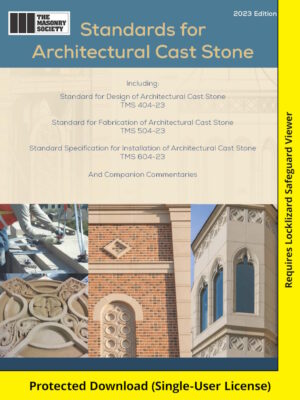
TMS 404/504/604 Standards for Architectural Cast Stone contains three coordinated consensus standards governing the design (TMS 404), fabrication (TMS 504), and installation (TMS 604) of architectural cast stone systems and elements.
This edition includes updated ASTM and ASCE/SEI 7-22 references, new out-of-plane deflection limits, revised drying shrinkage requirements, a minimum unit thickness of 2.5 in. (64 mm), and permission for GFRP reinforcement. Written for code adoption; includes non-mandatory Commentaries.
Other Formats:
This product provides a single-user license for this document. Please review the restrictions below. Click here to see alternative formats and multi-user options.
-

$75.00
TMS 404/504/604 Standards for Architectural Cast Stone contains three coordinated consensus standards governing the design (TMS 404), fabrication (TMS 504), and installation (TMS 604) of architectural cast stone systems and elements.
Other Formats: Printed Copy
This product provides a single-user license for this document. Please review the restrictions below. Click here to see alternative formats and multi-user options.
-
$35.00
The updated version of this Standard provides minimum requirements for rating masonry walls for a sound transmission class (STC) and added for 2012 outdoor-indoor transmission class (OITC) based on field or laboratory testing or based on a calculation procedure.
Other Formats: Printed Copy
This product is provided as a secure PDC file and can only be opened through the Locklizard Safeguard Viewer. Other PDF Viewers will not be able to read this file. This document can only be opened by a single user and allows limited printing of up to 2 watermarked copies. Read more about these limitations.